Fake plays, real losses: how streaming fraud takes money from the people who make music
Story
Bots pretending to be listeners have diverted millions of dollars and put the music industry on alert. A plain-language guide to how the scam works, who loses, what platforms and authorities are doing, and why Eventroo does not accept artificial streams.
Every fake play competes with a play from a real fan.
Think of your favourite song playing in someone's headphones right now. Every time it plays, part of the money you pay for your subscription, or that the platform earns from ads, goes to the people who created that song: the singer, the songwriters, the producers, the label, the publisher. That is how streaming pays for music.
Now imagine that, on the other side, nobody is listening. There is a bot. It hits play thousands of times without liking the song, sharing it or going to the show. Just to generate numbers and, with them, money. This has a name: streaming fraud. And in 2026 it stopped being a backstage issue and became a criminal case, the subject of a public consultation in the United States and a priority for the industry's biggest organisations.
In this article, Eventroo explains what is happening, who loses and what you, as an artist, songwriter or fan, need to know. No legal jargon.
First, the basics: what is a fake stream?
A stream is a play of a song on a digital platform such as Spotify, Apple Music, Deezer or YouTube Music. A fake stream, or artificial stream, is a play that does not come from a person interested in the music. It is manufactured.
Term
In plain words
Bot
A program that imitates a listener and presses play automatically, with nobody actually listening.
Streaming farm
Many phones, computers or accounts running at the same time just to play music and inflate the numbers.
Royalties
The money a song generates, split among everyone who holds rights to it.
Rights holders
The people and companies entitled to be paid: artists, songwriters, producers, labels and publishers.
Distributor
The company that takes the artist's music to the platforms. Eventroo is one of them.
Why this takes money from real people
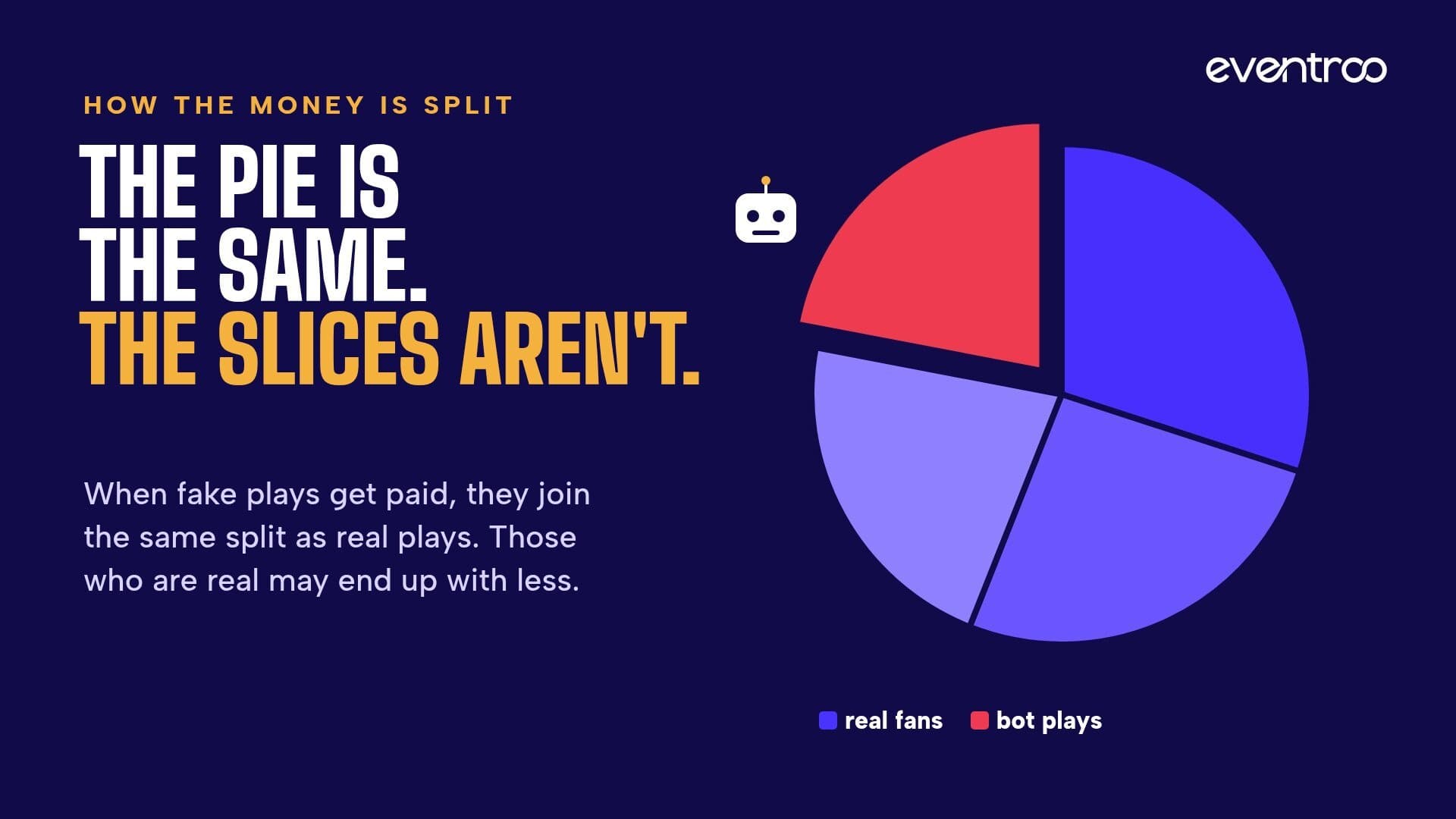
On many services, the money collected in a period works like a pie, split according to the share of plays each song received. If some of those plays are fake and still get paid, the pie does not grow: there are just more people cutting slices. Those with real plays may end up with a smaller piece.
Fake plays that get paid compete in the same split as plays from real fans.
The exact effect varies from platform to platform: it depends on each service's commercial rules, how the money is split and how much fraud is detected before payment. But the logic is clear: when someone cheats, someone honest pays the bill.
In a column published on 21 October 2026 in Billboard Pro, David Israelite, president and CEO of the National Music Publishers' Association (NMPA), the US music publishers' association, highlighted a point that is often left out: fraud does not only hurt singers and labels. Songwriters and publishers also lose when the data that drives payments is manipulated.
How the scam works
Fraudulent operations use automated accounts, devices or coordinated networks to simulate listeners. Some also spread a huge volume of tracks so that the suspicious activity is "diluted" across many songs and goes unnoticed.
The damage goes beyond money. Charts, campaign results and even investment decisions end up based on inflated numbers. It is like an election with fake votes: the result no longer says what the public really wants.
Bots: automate plays and create fake accounts.
Data: distort audiences, charts and campaigns.
Royalties: divert payments away from real people.
The case that became a symbol: more than US$ 8 million
According to the US Department of Justice, American Michael Smith pleaded guilty on 19 March 2026 and was sentenced on 6 October to 18 months in prison. According to the authorities, he used hundreds of thousands of tracks created with artificial intelligence and billions of bot plays to fraudulently obtain more than US$ 8 million in royalties.
The scheme ran from 2017 to 2024. In addition to prison and two years of supervised release, the court ordered the forfeiture of US$ 8,091,843.64. The lesson is straightforward: manipulating streams is not just breaking a platform rule. It can be a crime.
What Deezer's numbers show
Almost 90,000 fully AI-generated tracks reached Deezer per day, on average, in 2026.
In June, at the peak, they made up more than 50% of all new music uploaded to the platform.
Even so, they accounted for only 1% to 3% of plays.
Up to 85% of the plays of these tracks in 2025 were classified as fraudulent by Deezer.
The figures come from a statement dated 21 July 2026. In other words: a lot of music coming in, few people listening and, among the plays, a large share that was fake. Deezer said it removed the fraudulent plays it identified from royalty payments. One word of caution: these numbers are Deezer's and should not be applied automatically to the whole market.
Careful: artificial intelligence is not the same as fraud
Using artificial intelligence tools to create music is not, in itself, fraud. The problem starts when the technology is used to manufacture audiences, manipulate results, claim rights that do not exist or collect payments that are not owed. Eventroo distributes music made with AI, as long as the track is flagged and the rights are in order; see how on the AI Music page. Questions about authorship and permission for AI content are a separate debate, and an equally important one.
The same technology that scales up abuse also helps fight it: it makes it possible to spot unusual listening patterns, monitor releases and stop problems before they reach the platforms.
The industry joins forces and the authorities step in
On 14 September 2026, the International Federation of the Phonographic Industry (IFPI) announced the Streaming Integrity Initiative, a commitment signed by distributors, with the support of labels and industry bodies, to prevent, detect and respond to fraud. The idea is that everyone follows a common baseline of practices and shares information.
On 7 October 2026, the U.S. Copyright Office, the US government's copyright office, opened a public consultation on the subject at the request of the US Congress. The goal is to understand the manipulation methods, the economic effects and the possible responses, whether voluntary, legal or regulatory. After an extension announced on 5 November, initial comments can be submitted until 18 December 2026, and reply comments until 29 January 2027.
Israelite, of the NMPA, argues that songwriters and publishers must also have a seat at that table. After all, data manipulation affects both the recording (the master) and the musical work (the composition), which have their own licensing and collection systems.
Where Eventroo stands
Eventroo does not tolerate fake streams, bots or any kind of number manipulation. Good music deserves a real audience, and the people who create it deserve to be paid for what is theirs.
As a distributor, Eventroo is one of the doors through which music reaches the platforms. That is why we take the responsibility of protecting that path seriously. Our Terms of Use prohibit using or buying artificial streams, bots or any manipulation of numbers. In those cases, Eventroo may refuse the content, suspend or close the account and report it to the authorities and the platforms.
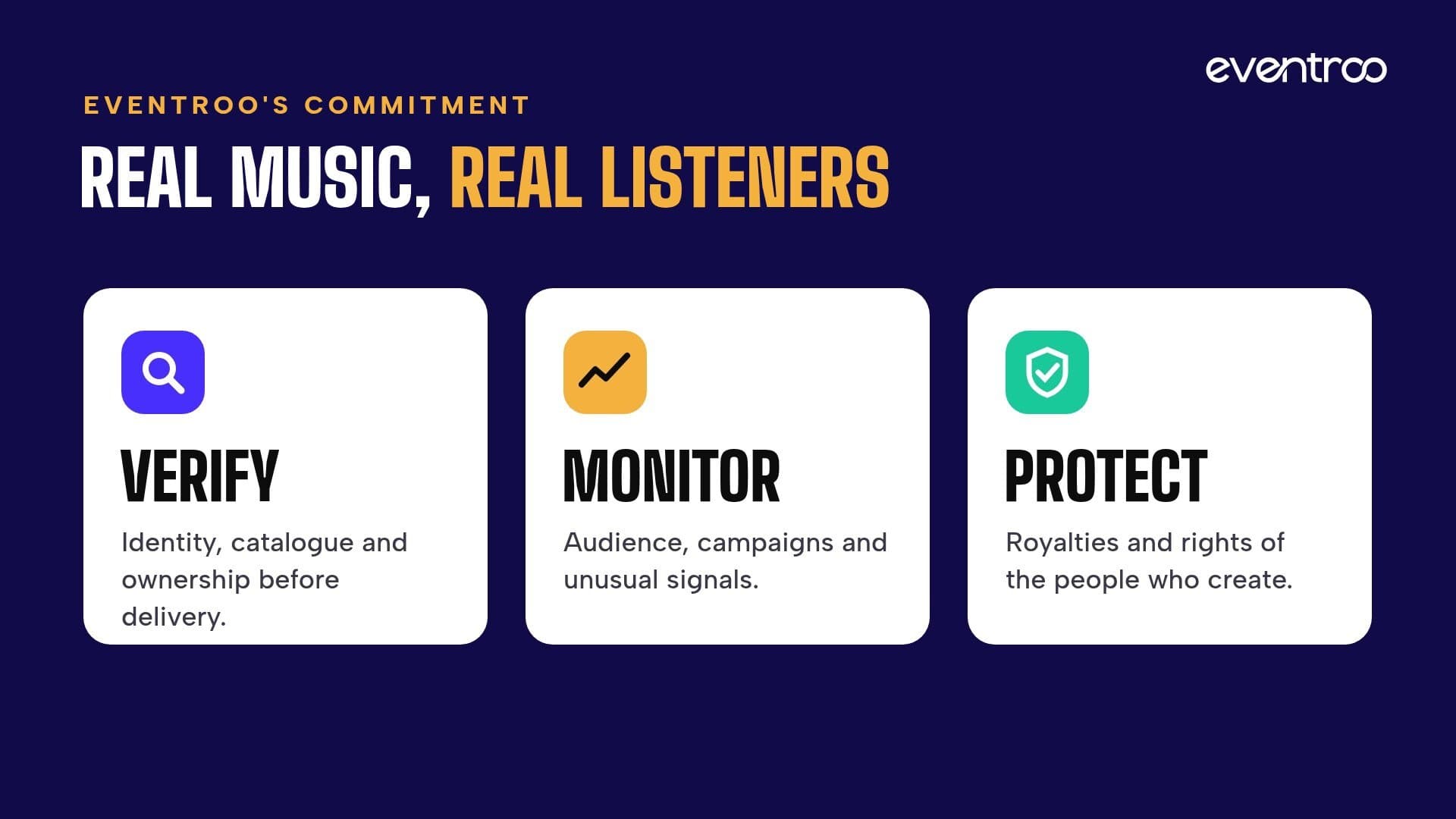
In practice, this rests on three principles:
Verify: check identity, catalogue and ownership before the music reaches the platforms, and ask for documents when needed, including after the release.
Monitor: watch for signs of unusual growth, traffic from doubtful sources and campaigns that promise guaranteed plays, following written review rules.
Protect: defend the royalties and rights of the people who create, with proportionate decisions and the right to appeal when a procedure is available, so that legitimate artists are not punished without evidence.
Eventroo's three pillars against artificial streaming.
Defending the artist also means defending the songwriter, the producer, the label and the publisher. Every fake play that gets paid takes a little value away from someone who did real work. Eventroo exists so that this value reaches the people it belongs to.
Artists: how to protect yourself
Many people fall into fraud without realising it, by hiring a "boost" that looks harmless. Watch out for these signs:
A promise of a guaranteed number of plays, listeners or followers.
Packages priced per thousand plays, with no explanation of where the audience comes from.
Very fast growth from countries or cities with no connection to your work.
An agency that will not show how the campaign works or where the ads appear.
Important: if the manipulation was done by an agency or partner you hired, the platforms can still take action. They can discount streams, withhold or claw back royalties, remove songs and restrict profiles. Promoting your music is allowed and encouraged: paid advertising is welcome when it seeks a real audience. Learn more in the Takedowns, disputes, fraud and artificial streaming section of the Eventroo FAQ.
What is at stake
Streaming rests on a simple promise: the number on the screen corresponds to real people listening, and the money it generates goes to those who are entitled to it. Without that trust, everyone loses: artists, labels, publishers, brands, investors and the audience itself, which starts seeing charts that reflect nobody's taste.
The answer involves rights verification, transparent reporting, detection of artificial traffic, auditing and cooperation between platforms, distributors and rights holders. Technology helps, but it does not replace clear rules and human judgement.
Protecting streaming is not just about deleting fake plays. It is about making sure a song's success reflects the real affection of its audience, and that the music economy pays the people who create, produce and invest correctly.